The Radical Simplicity Method
A Whitepaper on Building AI-Powered Teams
A Survival Guide for the Transition
"The agents are coming. This whitepaper is a bandaid."
Executive Summary
The window for humans to matter in knowledge work is closing. AI agents—autonomous systems capable of executing complex workflows without human intervention—are arriving faster than most people realize. This whitepaper offers a methodology for staying relevant during the transition.
The Problem: Organizations are struggling to adopt AI effectively. The failure isn't technological—it's linguistic. Most of what passes for complexity is actually confusion: jargon that obscures meaning, terms that drift from their definitions, and accumulated fog that prevents clear thinking and clear instruction.
The Solution: The Radical Simplicity Method—a meta-skill for cutting through linguistic confusion to describe work clearly enough that it can be systematized. This isn't about simplification; it's about root-level clarity that makes AI useful and keeps humans valuable.
The Opportunity: Those who master this skill become Translators and Orchestrators—the people who can bridge human intention and machine execution. They don't just survive the transition; they help build what comes next.
What This Whitepaper Offers:
- A hypothesis about complexity and clarity worth testing
- A practical methodology you can apply today
- A framework for thinking about the AI transition
- An invitation to try it on a real problem
The agents are coming. The question is whether you'll be building them, directing them, or replaced by them.
Preface
What This Is (and Isn't)
I wrote this whitepaper in 24 hours with AI help. That doesn't prove the methodology works—it proves I can write fast with AI. Circular logic is the enemy of clear thinking, so let me be straight with you from the start.
I don't know if what's in this whitepaper is correct.
I suspect it is. I've spent 25 years as a systems integrator, building workflow systems, trading platforms, and enterprise architectures. I've seen the $6 million decks that go nowhere. I've seen small teams outperform armies of consultants. I've been the "fixer" who comes in after the big firms leave.
And in the last year, working intensively with AI, I've noticed something that might be important: most of what passes for complexity is linguistic confusion. Strip away the jargon, and many "transformation" problems collapse into simple problems with simple solutions.
That's a hypothesis, not a fact. This whitepaper is my attempt to articulate it clearly enough that you can test it yourself.
The Core Principles of Radical Simplicity
Before we go further, let me articulate the foundational principles:
1. Clarity precedes capability. You cannot automate what you cannot describe. You cannot improve what you cannot articulate. The first step in any transformation is linguistic precision.
2. Root-level, not surface-level. "Radical" comes from the Latin radix—root. We're not simplifying for simplicity's sake; we're cutting to the root of what things actually mean and what actually needs to happen.
3. The meta-skill enables all other skills. Learning to clear language isn't just one skill among many—it's the foundation that makes AI useful, makes communication effective, and makes execution possible.
But I need to be honest about something else: this whitepaper is a survival guide, not a permanent solution.
The window for humans to matter in knowledge work is closing. AI agents are coming. Not the chatbots we had two years ago—autonomous systems that can execute complex workflows without human intervention. They're not fully here yet. But they're coming faster than most people realize.
What I'm offering is a methodology for staying relevant during the transition—a critical method for navigating this window. A way to squeeze out a few more months—maybe a few more years—of being valuable.
If that sounds dark, it's because it is. But I'd rather give you an honest survival guide than a comforting lie.
— Stephen, 2 AM, November 30, 2025
Chapter 1: The Window
Why the next few months might be the most important of your career

I'm going to tell you something that sounds dramatic, and I need you to hear it without the drama: AI agents are coming for knowledge work, and they're coming faster than most people realize.
Not "AI tools." Not "copilots." Agents—systems that can take a goal, break it into tasks, execute those tasks, evaluate the results, and iterate. The thing you do at your job, but without needing you.
They're not fully here yet. But here's the thing: I can do this today. Right now. I can orchestrate AI systems to execute complex knowledge work that would have required a team of specialists two years ago. I can't even imagine what I'll be able to do in 3 months.
The reader is lucky—there aren't thousands of me right now. But there will be. Because those who can almost do what I do will be able to do what I do in 3-6 months. When that happens, we're so close to doing it without the practitioner that I don't even want to think about it.
Watch the curves. The models are getting better every quarter. The cost per token is dropping exponentially. The tooling for agents—the scaffolding that lets AI systems act autonomously—is being built right now by thousands of startups. And by people like me.
My bet: the first wave hits within months. Not years. Months. The organizations that are already building agent workflows will have 10x advantages over those that aren't. Within 1-2 years, this will be everywhere.
I might be wrong about the exact timeline. But I'm confident about the direction. The question isn't if—it's when. And "when" is a lot sooner than most people want to believe.
What This Means For You
If I'm right, there are only three positions you can be in when the wave hits:
Position 1: Replaced. Your job gets automated. You didn't see it coming, or you saw it and didn't act. Someone else built an agent that does what you do, faster and cheaper. You're not needed anymore.
Position 2: Augmented. You learned to use AI so well that you're 10x more productive than you were. You're valuable because you know how to get results that pure AI can't—yet. This buys you time, but the clock is still ticking.
Position 3: Orchestrating. You're the one who knows how to deploy, manage, and direct AI agents. You're not doing the work; you're designing the systems that do the work. This is the only position with any durability.
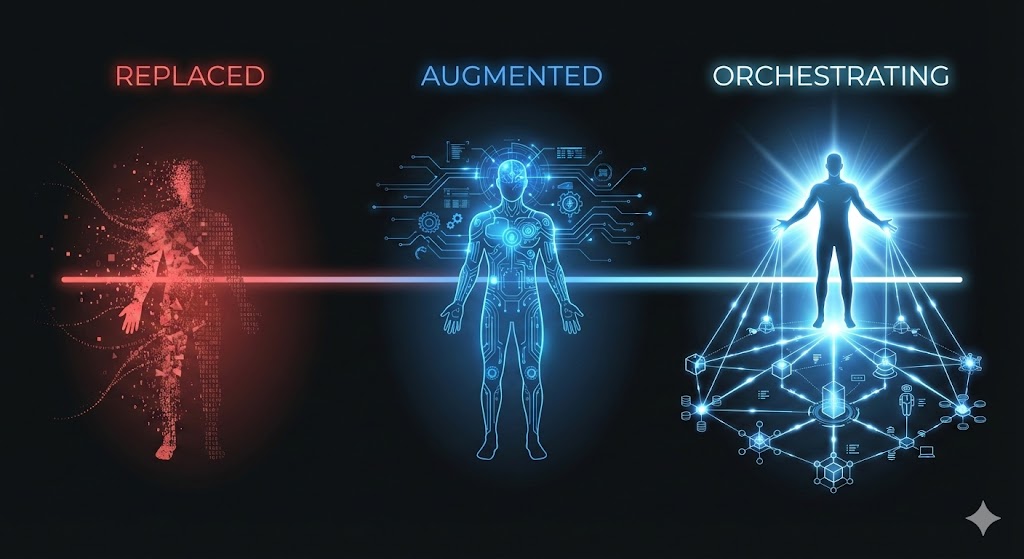
The window we're in right now—where AI is powerful but not autonomous, helpful but not reliable—is your chance to move from position 1 to positions 2 or 3.
This is not a future problem. This is a now problem. The decisions you make in the next few months will determine which position you're in when the wave hits.
What This Whitepaper Is For
I'm not going to tell you how to build AI. I'm not going to teach you prompt engineering. I'm going to share a methodology for thinking clearly—which turns out to be the skill that makes AI useful and the skill that keeps you relevant when AI gets better.
More specifically: I'm going to try to teach you how to describe your work clearly enough that it can be systematized.
Why does that matter? Because agents need instructions. They need to know: What triggers this process? What information is required? What are the decision points? What are the outputs? Who needs to know what, when?
The people who can articulate their work will be able to build agents that do their work. Or direct others who build agents. Either way, they're on the right side of the transition.
The people who can't articulate their work? They're waiting to be automated by someone who can.
This whitepaper is a survival guide for that transition. Not a permanent solution—there are no permanent solutions right now. But maybe enough to help you find your footing before the ground shifts completely.
Chapter 2: What AI Actually Is
A cleared definition for practical use (December 2025)
Before we go further, we need to clear what AI actually is. There's so much hype and fear swirling around that it's hard to think straight.
I'm not going to give you the computer science definition. I'm going to give you the practical definition—what AI is and isn't for someone trying to use it in organizational work.
A critical note on timing: AI capabilities are advancing so rapidly that anything I write here has a shelf life measured in months. What follows is accurate as of late 2025. By the time you read this, some limitations may have shifted.
The Current State (Late 2025)
The major models as of this writing:
GPT-5 — Stunning. OpenAI's latest represents a significant capability jump from GPT-4.
Grok 4 — Terrifyingly effective. xAI's model has closed gaps faster than anyone predicted.
Gemini 3 — Google's current flagship, with multimodal capabilities that continue to expand.
Claude 4.5 Opus — Anthropic's most capable model. With proper guidance, it puts most developers I've worked with to shame. I simply don't need to write code anymore.
Up until the last update cycle, I would have argued vehemently that I am still smarter than the AIs. But this last update—for each of them—shocked me. The interactions shifted in a way that was highly noticeable. I had to admit to myself: I think these things are smarter than me now.
That's not a benchmark claim. That's a practitioner's observation after thousands of hours of interaction. Take it for what it's worth.
What AI Excels At (Currently)
Rapid assimilation of large information sets. Give an LLM a hundred pages of documents and ask it to summarize. It will do in minutes what would take a human hours.
Intelligent distillation. Extracting key points, finding contradictions, identifying patterns across large datasets.
Complex reasoning tasks. OpenAI's o1 and subsequent reasoning models achieve 83% on AIME 2024 (the American Invitational Mathematics Examination). Chain-of-thought reasoning has advanced significantly beyond simple pattern matching.
Code generation and system building. With proper orchestration, current models can architect and implement entire systems. The "AI can't really code" era ended sometime in 2024.
First-draft generation. Producing 60-80% of written content rapidly, which humans can then refine—though increasingly, the refinement step is optional.
What AI Still Struggles With (For Now)
Consistent truth assessment. AI cannot reliably determine if something is true. It can produce plausible-sounding falsehoods with complete confidence. Hallucination rates have improved but remain significant. Retrieval-Augmented Generation (RAG) helps by grounding outputs in documents, but it's a workaround, not a solution.
Accountability. AI cannot be responsible. It cannot face consequences. It cannot be sued or fired or shamed. If something goes wrong, a human is accountable.
Meta-awareness of errors. Models still struggle to recognize when they don't know something. They don't spontaneously produce self-reflective comments unless explicitly prompted.
Context humans know but haven't stated. The implicit knowledge in your organization—the politics, the history, the relationships—AI doesn't have access to any of it unless you explicitly provide it.
Judgment about what matters. AI cannot tell you what's important, appropriate, or aligned with your values. It can only optimize for objectives you define.
The Trajectory Matters More Than The Snapshot
Everything I've written about AI's limitations has a shelf life. Six months from now, some of these limitations may be solved. A year from now, the whole landscape might be different.
The underlying principle—that AI augments human clarity rather than replacing human judgment—I suspect will hold longer. But I could be wrong about that too. And even if I'm right, "longer" might mean months, not years.
What matters isn't where AI is today. What matters is the slope of the curve. And that slope is steep.
Chapter 3: Introducing Your AI Consultancy Team
What it is and how it works
To truly grasp the power of the Radical Simplicity Method, you need to understand what an "AI Consultancy Team" actually is. This isn't just about individual AI tools—it's about a highly specialized, dynamic collective, orchestrated by human intelligence and precision, applying Radical Simplicity to tackle complex organizational challenges from within.
What Is an AI Consultancy Team?
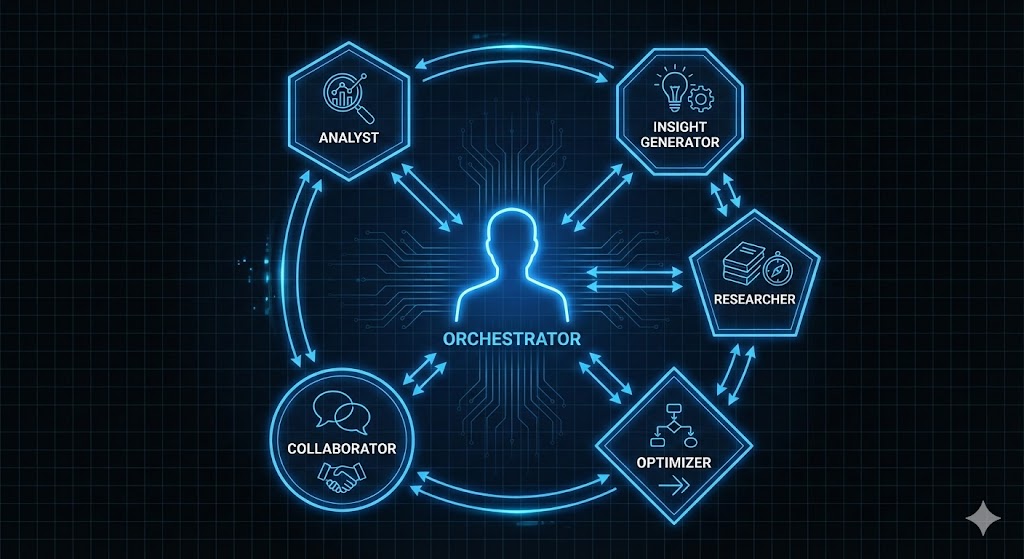
An AI Consultancy Team is an internal, personalized resource composed of specialized AI agents (or AI-augmented human roles) acting as a "thinking partner." Unlike traditional consulting—where outsiders gather information, produce recommendations, and leave—an AI Consultancy Team operates continuously from within your organization.
The critical distinction: its effectiveness relies entirely on human clarity. The Radical Simplicity Method is the enabling layer. Without clear problem definitions, clear decision criteria, and clear output specifications, even the most sophisticated AI agents will produce confused results.
The Structure: Orchestrators and Specialists
An effective AI Consultancy Team has two layers:
The Orchestrator (Human)
This is you—or whoever applies the Radical Simplicity Method to define problems with crystalline clarity. The Orchestrator:
- Breaks complex problems into foundational components
- Asks the uncomfortable questions: "What exactly are we trying to achieve?" and "How can this be systematized?"
- Creates clear definitions that become operating instructions for AI agents
- Designs workflows, monitors progress, and interprets integrated outputs
The Specialized AI Agents
Each agent has a specific function. Here's how a team might be composed:
Associate Analyst: "My role is to ingest datasets, identify trends, and surface key performance indicators. The Orchestrator's clear directives allow my analytical capabilities to swiftly process information, bypass noise, and deliver structured quantitative insights—transforming raw data into decision-ready reports."
Associate Insight Generator: "My specialty is synthesizing diverse information, connecting seemingly unrelated points, and distilling the 'so what?' from complex narratives. With the Orchestrator's radically simplified problem statement as my guide, I rapidly cross-reference research, identify emergent patterns, and craft compelling narratives that translate data into strategic understanding."
Associate Researcher: "My contribution is ensuring we have the most current and relevant external information. I conduct targeted, high-precision web reconnaissance, competitive analysis, and trend identification. The precise parameters set by the Orchestrator prevent information overload and ensure I gather only the most pertinent intelligence."
The "Thinking Partner" in Action
Here's what an iterative human-AI CT interaction looks like:
Problem: Sales are declining in the Northeast region, and leadership wants a "transformation initiative."
Orchestrator's First Move: Clear the language. "Transformation into what? What specific outcome would indicate success? What's actually happening in the data?"
Analyst Agent: Processes 18 months of sales data, identifies that decline correlates with three specific product lines and began six months after a pricing change.
Insight Generator: Cross-references with customer feedback data, finds complaints about price-to-value perception specifically for those products in that region.
Orchestrator's Refinement: "So the hypothesis is: pricing change → perceived value mismatch → sales decline. What would validate this?"
Researcher Agent: Finds competitor pricing data showing they absorbed costs rather than passing to customers in that region.
Resolution: The "transformation initiative" becomes a targeted pricing adjustment for three products in one region. No $2 million consulting engagement. No 18-month roadmap. A clear problem with a clear solution.
Why This Replaces Traditional Consulting
Traditional consulting gathers counsel—research, interviews, analysis—and delivers recommendations. The work often stalls at implementation because:
- The people who must execute didn't build the plan
- They don't fully understand it
- The consultants have moved on
An AI Consultancy Team is different:
- It operates continuously, not in engagement phases
- It's internal, so context isn't lost
- The humans who define the problems are the humans who implement the solutions
- The AI handles the research and synthesis that used to cost millions
The consulting function isn't gone—it's internalized. And it's enabled by the clarity that the Radical Simplicity Method provides.
Chapter 4: The $6 Million Deck
A pattern I've observed—your mileage may vary
Early in my career, I became what you might call an "anti-consultant." Companies would hire me after the big firms left. My job was to figure out why the $6 million transformation project was stalled, and then actually make something work.
Let me be clear about something: I'm not against consulting. I'm saying that consulting—the gathering of counsel, the research, the synthesis—is now an internal function. The tools exist for anyone inside an organization to do this work themselves.
I saw the same pattern over and over. A major consultancy would deliver a beautiful deck—hundreds of pages of analysis, frameworks, and recommendations. The deck would sit in a drawer. The transformation would stall. Someone like me would get called in to pick up the pieces.
This isn't universal. Some big consulting engagements work brilliantly. I've seen it happen. But I've seen this pattern enough times to suspect it's common.
The Pattern
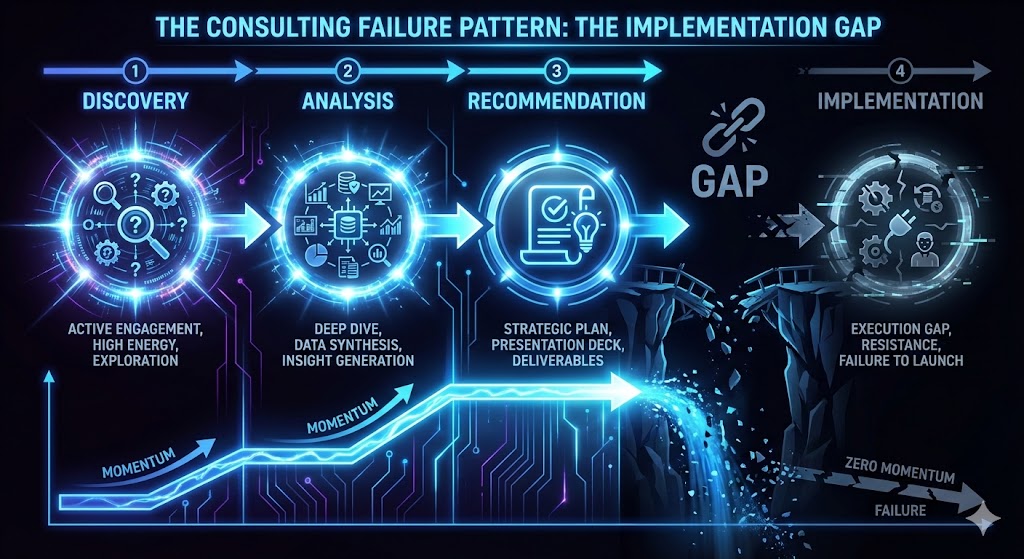
Here's what I typically observed:
Phase 1: Discovery. Consultants interview everyone. Workshops happen. Data gets collected. This phase feels productive because there's lots of activity.
Phase 2: Analysis. The data gets crunched. Frameworks get applied. Beautiful visualizations emerge. This phase feels smart because the output looks impressive.
Phase 3: Recommendation. The deck gets delivered. It's comprehensive. It's strategic. It addresses everything. Leadership nods approvingly.
Phase 4: Implementation. This is where things often stalled. The people who have to execute didn't build the plan. They don't fully understand it. They have day jobs. The consultants are moving on to the next engagement.
The gap between Phase 3 and Phase 4 is where transformation projects often go to die. This is precisely where linguistic confusion compounds—where the jargon that sounded impressive in the deck becomes impossible to translate into actual work.
The Artifact of Collection vs. The Instrument of Action
I've analyzed why I never—not once in 20 years—used the "Implementation Guide" left behind by these firms.
If we clear the word Consulting to mean "the summoning of counsel," the mystery vanishes. The $6 million deck is not a blueprint. It is a receipt. It is proof that they summoned the data, interviewed the people, and gathered the facts.
They collected the dots, but they didn't know how to connect them.
When I arrived as the "fixer," I ignored their document completely. I went straight to the Project Sponsor, the Subject Matter Experts, and the team. I asked them what they needed, and then I built it.
The consultants provided a static snapshot of the problem (Counsel). I provided the dynamic execution of the solution (Integration). The error wasn't in their work; it was in the expectation that a "Summoner" could do the work of a "Builder."
The Data Supports This
This observation isn't just my experience. The failure rates are documented—often by the consulting firms themselves:
McKinsey: Less than 30% of transformations succeed (unchanged for 10+ years)
BCG: 75% failure rate for value-creating, enduring change (2024)
Bain: Only 12% of business transformations achieve their original ambition (2024)—meaning 88% fail
Standish Group: 69-71% of technology projects end in partial or total failure (CHAOS Report 2015/2020)
McKinsey's own "Losing from Day One" study found that 55% of transformation value loss occurs during and after implementation—directly supporting the "Phase 3 to Phase 4" gap I observed. An additional 20% is lost after implementation completes. Only 12% of companies sustain transformation goals beyond three years.
The pattern extends to AI specifically: research shows 70-98% of AI project failures stem from organizational issues—siloed teams, poor data, unrealistic expectations, lack of strategic alignment—not technical limitations. The technology works. The organizations don't.
Why This Matters Now
Here's why this old pattern is suddenly urgent: the AI transition won't wait for your transformation project to finish.
The companies that are going to win the next few years aren't running 18-month transformation initiatives. They're shipping agent workflows in weeks. They're iterating in days. They're moving at the speed of software, not the speed of consulting.
If your organization is still in the "discovery phase" of AI adoption, you're already behind. If you're waiting for a comprehensive strategy before taking action, you're already behind. The window is too short for traditional transformation timelines.
The question worth asking isn't "how do we do transformation right?" It's "how do we move fast enough to matter?"
What If Consulting Is the Bottleneck?
Here's a thought that might be uncomfortable:
Consulting might be dead and just not know it yet.
I'm not saying consultants are bad or that the work they do has no value. I'm saying that work—the research, the synthesis, the counsel—is now something anyone inside your organization can do with the right tools and methodology.
What we really need today are partners and innovators. And if leaders inside the company apply the formula I lay out in this whitepaper, I believe the organizations will be better off, the people better off, and—if I'm right—maybe, just maybe, some of those failed AI automation projects will start to succeed.
What if traditional consulting is the bottleneck, coupled with disempowered internal resources, and not the capability of AI?
What if somebody throws around a phrase like "cyber security concerns" or "intellectual property risks" or some other buzzword that sounds serious but means nothing, has an easy solution, and by spouting those phrases as the reason not to move forward, they are actually sabotaging the very company they work for—or worse, consult for?
I've watched this happen. Smart people hiding behind vague objections because change is scary, because their value is tied to the old way, because admitting AI can do their job means admitting their job might not exist in two years.
The blockers aren't protecting the company. They're protecting themselves. And the company pays the price.
If you're a leader reading this: the next time someone kills an AI initiative with a buzzword, ask them to clear it. Ask them what "cyber security concern" actually means in this specific context. Ask them what the actual risk is, what the mitigation would cost, and whether that cost is higher than the cost of not moving.
Watch what happens when you demand clarity instead of accepting fog.
This whitepaper is a call to action for the people inside organizations to stand up, step up, and do their own consulting and research. The tools exist. The methodology is here. The only thing missing is you.
Chapter 5: The Linguistic Confusion Hypothesis
A hypothesis that might be useful

Here's what I suspect, but can't prove:
Much of what we experience as complexity in organizations is actually linguistic confusion. People using the same words to mean different things. Jargon that signals belonging but obscures meaning. Accumulated drift between what words originally meant and what they've become.
If this hypothesis is true, then a significant portion of "hard problems" aren't hard at all—they're just unclear. And clarity is achievable through a disciplined process of stripping away the linguistic fog.
If this hypothesis is false, then I'm offering you a methodology that will occasionally help but won't be transformative. Still useful, but not the lever I think it might be.
I invite you to test it and tell me what you find.
How Jargon Walls Get Built
Every field develops specialized language. Some of it is useful—precise terms for precise concepts. But some of it becomes a barrier.
New practitioners learn terms through osmosis, not definition. They hear "digital transformation" a hundred times before anyone explains what it means. By then, they assume they know.
Experts struggle to explain their field clearly because they've forgotten what it's like not to know the jargon. The curse of knowledge is real.
Over time, terms drift from their original meanings. "Strategy" once meant the art of the general. Now it means almost anything that sounds important.
This drift creates a strange situation: people in the same meeting, using the same words, can have completely different mental models of what's being discussed. They all nod. They all leave with different understandings. Projects fail, and no one knows why.
The Research Supports This
This isn't just intuition. Bullock & Bisbey (2025) found jargon "impairs processing fluency" and "undermines employees' confidence." A Columbia Business School study (2020) demonstrated that people with lower status use more jargon as status signaling—it's a social tool, not a communication tool. Patoko & Yazdanifard (2014) concluded business jargon "impedes daily communication and success."
André Spicer's Business Bullshit (2017) and Don Watson's Death Sentences (2003) both documented how meaningless corporate language damages organizational effectiveness.
Why This Matters For Agents
Here's why linguistic clarity suddenly matters more than ever: you can't automate what you can't describe.
An AI agent needs instructions. Clear, specific, unambiguous instructions. It needs to know: What triggers this process? What information do I need? What decisions do I make, based on what criteria? What do I output? Who do I notify?
If your work is wrapped in jargon and implicit knowledge, you can't hand it to an agent. You can't even hand it to a new employee effectively. It's stuck in your head, inaccessible.
The people who can describe their work clearly will be able to systematize it. They'll be able to build agents, or direct others who build agents. They'll be on the right side of the transition.
The people who can't describe their work are sitting ducks. They're waiting to be automated by someone who looks at their job from the outside and says, "Oh, that's just a decision tree with some API calls. I can build that in a week."
A Case Study
A client came to me asking for help with their "digital transformation." They'd been told they needed one. They weren't sure what it meant.
We cleared the term. "Digital" = relating to digits, numbers, discrete values. "Transformation" = changing shape across states. So: changing the organization's shape using discrete, number-based tools.
Then we asked: what shape change do you actually need? What problem are you trying to solve?
It turned out they had a simple problem: their files were scattered across laptops, shared drives, and email attachments. People couldn't find things. Projects stalled because of information friction.
The "digital transformation" they needed was a shared drive with consistent naming conventions and some training. Not a $2 million initiative. Not an 18-month roadmap. A few thousand dollars and a few weeks.
I don't know if this will work for every "transformation" project. But it worked for that one. And it's worked for others.
Chapter 6: Intellectual Foundations
Standing on shoulders
The ideas in this whitepaper aren't new. They're old ideas applied to a new context. I want to be transparent about the intellectual lineage.
The linguistic confusion hypothesis traces back to Ludwig Wittgenstein's observation that "philosophy is a battle against the bewitchment of our intelligence by means of language." His therapeutic philosophy—the idea that many "problems" dissolve when we clarify our terms—directly parallels the claim that organizational complexity often reduces to semantic fog.
Alfred Korzybski's General Semantics (1933) established that "the map is not the territory"—that words can drift from reality, and that this drift causes real-world problems. His work on abstraction levels and word-reality relationships forms the foundation for linguistic clarity approaches.
The etymology-based clearing methodology I use has roots in several traditions: Heidegger's etymological investigations (he believed Greek words contained "primordial philosophical insights"), educational research on vocabulary retention through root analysis (Pierson 1989, Bagheri & Fazel 2010), and techniques developed in various learning contexts for word clarification.
The "radically adaptable" concept owes a debt to Heather McGowan's The Adaptation Advantage (2020), which argued before most that adaptability would become the core survival skill in the future of work. What I'm adding is the mechanism—the specific methodology for rapid domain entry and the application to AI transition specifically.
The three positions framework (Replaced/Augmented/Orchestrating) echoes academic taxonomies on human-AI collaboration, including Dellermann et al. (2019) and work published in Management Science (2024) on automation versus augmentation roles.
What I'm offering isn't invention—it's synthesis and application. Taking dispersed ideas from philosophy, linguistics, organizational research, and AI studies, and combining them into a practical methodology for surviving the current transition.
The value, if there is any, is in the integration and the timing.
With that foundation established, let's turn to the practical methodology itself.
Chapter 7: The Clear Methodology
A technical manual for cutting through fog
This chapter is a practical guide. It's the methodology I use, written as clearly as I can manage. You'll need a dictionary, an etymology resource (Etymonline.com works), and willingness to ask questions that might feel stupid.
I'm not claiming this is the best methodology or the only methodology. It's what I've found useful. Try it, adapt it, or throw it away.
The Five Steps (Detailed)
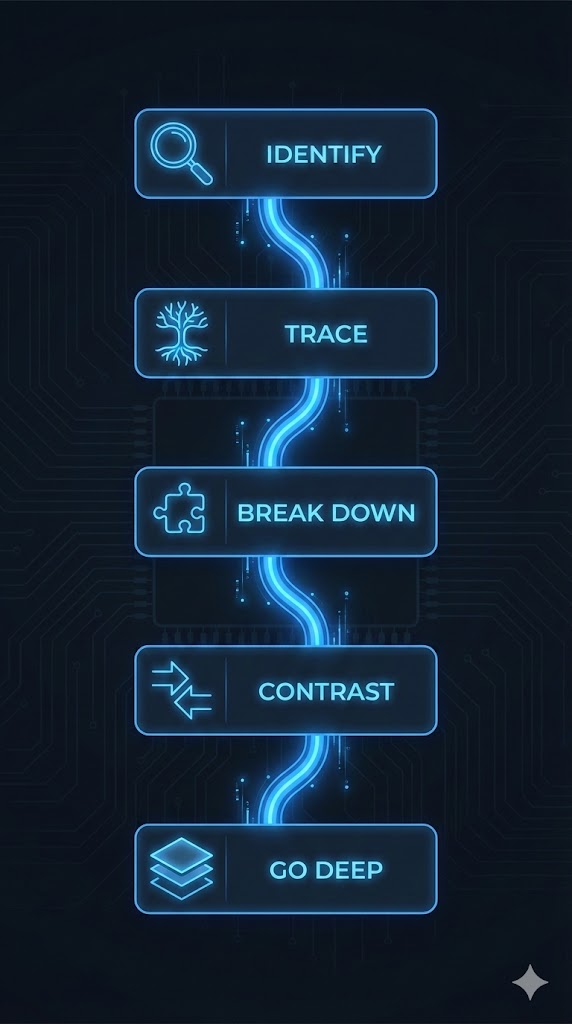
Step 1: Identify the Confusion Word
Listen for terms where people seem to have different definitions. Watch for vague jargon that sounds important but doesn't resolve into concrete meaning. Notice anything that makes you feel uncertain or confused.
Red flags: "We need to be more agile." "Let's leverage our synergies." "The AI transformation initiative." "We need better alignment." If you can't picture what success looks like in concrete terms, you've found a confusion word.
Step 2: Trace the Etymology
Go to Etymonline.com or a similar resource. Find out where the word came from. What was its original meaning? How did it evolve?
Example: "Strategy" comes from Greek "strategia"—the office of a general. Original meaning: the art of leading armies. Modern usage: any plan that sounds important. The drift is enormous.
Step 3: Break Prefix, Root, Suffix
Decompose the word into its components.
Example: "Transformation." Trans- (across, beyond). Form (shape, structure). -ation (the act of, the process of). Literal meaning: the act of changing shape across states.
Step 4: Contrast Original vs. Common Usage
How has the word drifted? Common patterns:
- Dilution: Strong meaning becomes weak
- Inflation: Simple meaning becomes grandiose
- Inversion: Meaning flips to something different
- Abstraction: Concrete meaning becomes vague
Example: "Disruption." Original: violently breaking apart, causing disorder. Common usage: "We made an app." The word has been so inflated that it's almost meaningless.
Step 5: Go 2-3 Levels Deep
Use a "why chain" until you hit bedrock. Keep asking "what does that mean?" until you can explain it to a 12-year-old without jargon.
Example: "We need better synergy." → What does synergy mean? → "When things work together well." → What does 'work together well' look like? → "When marketing and sales share information so they're not duplicating effort." → Now we have something concrete. Now we have something an agent could potentially do.
Common Confusion Words in AI Initiatives
If you're involved in AI work, here are terms worth clearing:
"AI-Native" — What does "native" mean here? Born into? Original to? What would an "AI-immigrant" organization look like? If you can't answer, the term is fog. To clear it: "Native" suggests something born into an environment rather than adapted to it. An "AI-native" organization would be one designed from inception around AI capabilities, rather than retrofitting AI onto existing structures. The practical question becomes: what specific design decisions differ between native and retrofitted approaches?
"Scale" — Scale what? To what size? Over what timeframe? "We need to scale AI" is not a goal; it's a vibe.
"Transformation" — Into what? From what? What will be different when it's done? How will you know?
"Empowerment" — Who gets what power to do what? Power over what? If you can't specify, you're not empowering anyone.
"Leverage" — Originally a physics term: using a lever to multiply force. Now it just means "use." Say "use" and see if the sentence still works.
"Agent" — This one's actually useful if you define it: a system that can take a goal, decompose it into tasks, execute those tasks, evaluate results, and iterate. If that's not what you mean, use a different word.
A Warning
This methodology has worked for me and for teams I've worked with. That doesn't mean it will work for you.
Every organization has different constraints, different cultures, different failure modes. What I'm offering isn't "the answer." It's a tool.
Try it. Adapt it. Throw it away if it doesn't fit. The only way to know if it works is to use it on a real problem and see what happens.
Chapter 8: The 2 AM Realization
What I actually understood that night

I need to tell you what actually happened on November 30, 2025, at 2 AM. Not the sanitized version. The real one.
For years, I built deterministic workflow systems for enterprises. SharePoint pipelines with custom decision-making code. Boring stuff. Business process automation before anyone called it that. Routes, approvals, conditionals, handoffs. The plumbing of how organizations actually function.
Separately, over the past year, I'd been building AI personas. Not for clients—for myself. Specialized identities that could think in particular ways. A researcher. An editor. A devil's advocate. A synthesizer. I stacked them in conversations, handed problems between them, watched them collaborate. It made my own work faster and better.
At 2 AM, these two threads collided.
The Collision
I realized: those old enterprise workflows I'd built? They're worth a fortune now. Not the code—the patterns. The understanding of how decisions flow through organizations. Because that's exactly what AI agents need. They need to know: What triggers this process? What information is required? What are the decision points? What are the outputs? Who needs to know?
And the AI personas I'd been playing with? They're not toys. They're agent identities. Stack them in workflows and you get swarms of specialized intelligence working on hard problems in parallel. Not "AI assistants." Autonomous systems that can execute complex work.
I thought: I should be helping large organizations with this. I have the workflow architecture experience. I have the AI persona development. I have the integration skills. This is exactly what enterprises need right now.
Then the darker thought arrived.
What If They're Not Ready?
The technology is ready. The organizations are not.
I've watched companies try to adopt AI. Most of them flail. They buy tools. They run pilots. They create "AI task forces." Nothing sticks. Not because the AI doesn't work, but because the humans can't describe their own work clearly enough to hand it off.
Ask someone what they do, and you get job titles and jargon. Ask them to describe the actual decisions they make, the information they need, the triggers and outputs and dependencies—and they can't. Not because they're stupid. Because no one ever asked them to articulate it.
And here's the brutal realization: agents are coming regardless. The question isn't whether. The question is: agents of what?
The answer, at least initially, is: agents of the work currently being done by humans. The processes. The decisions. The knowledge work.
The people who can describe their work clearly will be able to build agents that do their work. They'll become orchestrators. They'll multiply their value by 10x, 100x.
The people who can't describe their work? They'll be replaced by agents that someone else builds. They won't even understand what happened.
The Survival Window
Let me be blunt about what I think is happening.
We're in the last months—maybe the last year or two—of human knowledge work as we've known it. Not all of it. But a lot of it. The routine cognitive tasks. The processing. The coordination. The synthesis. All of it is being automated, right now, by people like me who know how to build agent workflows.
The organizations that figure this out first will have an almost insurmountable advantage. They'll operate at 10x the speed, a fraction of the cost, 24/7. Their competitors will be trying to hire humans while they're deploying swarms.
For individual knowledge workers, the window is even shorter. Your value right now is your ability to do cognitive work. That value is evaporating. Not slowly—rapidly. Every month, the models get better. Every quarter, more of what you do becomes automatable.
The Bandaid
This whitepaper is a bandaid. I want to be honest about that.
I'm not offering you a way to become permanently safe. There is no permanent safety. The technology is moving too fast. Whatever I write today will be partially obsolete in six months.
What I'm offering is a survival guide. A way to squeeze out a few more months—maybe a few more years—of relevance. A methodology for becoming the kind of person who can work with the agents rather than being replaced by them.
The core skill is this: the ability to describe what you do clearly enough that it can be systematized.
If you can articulate your work—the triggers, the inputs, the decisions, the outputs, the dependencies—you can build agents to do it. Or you can direct others who build agents. Either way, you're on the right side of the transition.
If you can't articulate your work, you're waiting to be automated by someone who can.
What I'm Actually Offering
So here's what this whitepaper is really about:
I'm trying to teach you to describe your work. To clear the jargon that obscures what you actually do. To break down your processes into components that can be systematized. To develop the meta-skill of articulation that will keep you valuable as long as possible.
Not because I think you'll be safe forever. But because I think the people who develop this skill will have options. They'll be able to pivot. They'll be able to orchestrate. They'll be able to contribute to building what comes next instead of just being swept away by it.
The agents are the future. But agents of what?
Initially: agents of the work currently being done by people.
The question is whether you'll be the one building and directing those agents, or whether you'll be the work that gets automated.
That's the choice. That's the window. That's why I wrote this at 2 AM.
Chapter 9: Fifteen Minutes to Real Value
A speed principle for clarity
This chapter introduces a methodology based on 15-minute cycles. It's not about rushing. It's about compressing feedback loops until clarity emerges faster than confusion can accumulate.
In a world where you might have months instead of years, speed isn't just efficiency. It's survival.
Why Fifteen Minutes
Parkinson's Law: work expands to fill the time available. If you have a week to solve a problem, you'll spend a week. If you have fifteen minutes, you'll focus on what actually matters.
Fifteen minutes is short enough to maintain focus but long enough to produce something concrete. It defeats perfectionism because you can't be perfect in fifteen minutes. It prevents fatigue because anyone can focus for fifteen minutes.
The math: a two-hour meeting produces one vague outcome. Eight 15-minute sprints produce eight concrete outcomes. Which would you rather have?
The Four Phases
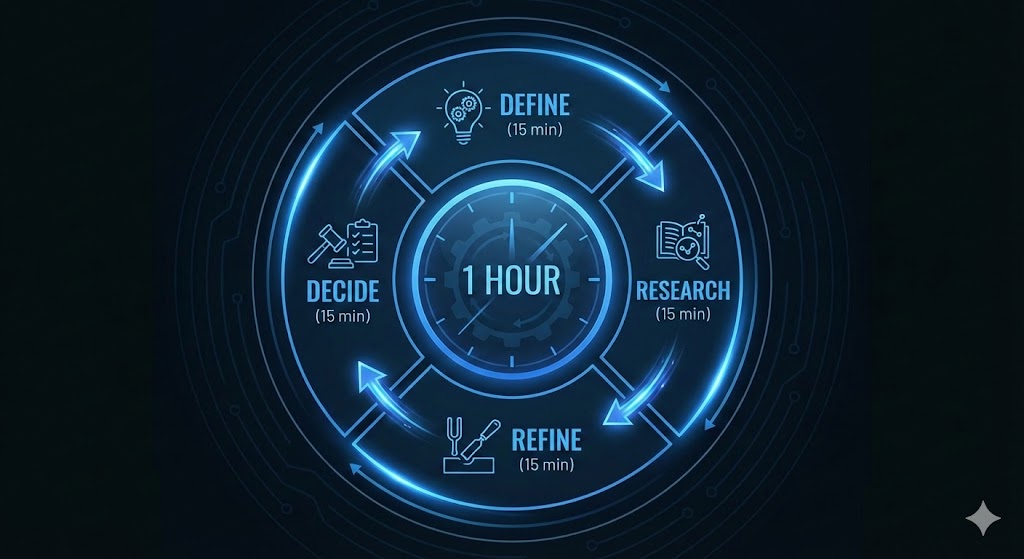
Phase 1: DEFINE (15 minutes). Articulate the problem in one sentence that a 12-year-old could understand. No jargon. What's solvable? What's observable? What's unknown? Output: a problem statement.
Phase 2: RESEARCH (15 minutes). Use AI for rapid search—solutions, context, approaches. What already exists? What constraints are we working with? Output: 3-5 potential approaches with pros and cons.
Phase 3: REFINE (15 minutes). Pick the most promising approach. What would we need to validate it? What's the smallest viable version? Output: a specific approach with first steps.
Phase 4: DECIDE (15 minutes). Commit to a next action. Who owns it? What's the deadline? What does success look like? What's the next decision point? Output: an assigned action with deadline and criteria.
Why This Matters For Agent-Readiness
Here's the connection to everything else in this whitepaper: each cycle of Define-Research-Refine-Decide produces an artifact. A clear problem statement. A set of evaluated options. A specific approach. A concrete action.
These artifacts are exactly what agents need. They're the instructions. The triggers. The decision criteria. The output specifications.
Every time you run this cycle, you're not just solving a problem. You're documenting your thinking in a form that could eventually be systematized. You're practicing the skill of articulation that will keep you valuable.
The 15-minute sprint isn't just a productivity hack. It's training for the transition.
Chapter 10: Radically Adaptable
Building people who can step into new domains
In my career, I've stepped into roles I had no formal training for: CTO, enterprise architect, trading systems developer, AI consultant. Each time, I had to get competent fast in a domain I didn't know.
I used to think this was a quirk of my personality. It wasn't. It started at five, when I taught myself to read and realized that authority figures don't always know what they claim to know. By eighteen, I'd committed to learning the mechanics of everything I could—not to become an expert in every field, but to understand how systems actually work beneath the jargon.
That curiosity turned me into something useful: a translator. I can look at a workflow in marketing, technology, finance, or operations and spot where the logic breaks. Not because I'm the best specialist in any domain, but because I've done enough of the work—hands-on, not theoretical—to recognize when something doesn't fit.
Today, that skill is the safety valve for AI. Agents hallucinate. They drift. They produce confident nonsense. The only defense is someone who understands enough of the domain to catch the errors before they compound.
The methodology that follows isn't abstract theory. It's what I've actually used to get competent in new domains fast enough to be useful.
What "Radically Adaptable" Means
Let's clear the term. "Radical" comes from Latin "radix"—root. Radical change is change at the root level, not at the surface.
"Adaptable" means capable of adjusting to new conditions.
"Radically adaptable" means: capable of fundamental adjustment at the root level to entirely new conditions.
This isn't about being a generalist or a polymath. It's about having a methodology for rapid competence development. Knowing what questions to ask. Knowing how to find and validate information quickly. Knowing how to identify transferable patterns.
The Adaptability Method
Step 1: Clear the domain. What are the key terms? What do they actually mean? (Use the clearing methodology from Chapter 7.)
Step 2: Find the patterns. What's analogous to things you already know? What principles transfer from other domains?
Step 3: Identify people who actually operate here. Not pundits. Practitioners. What do they know that isn't written down?
Step 4: Rapid immersion. Use AI to synthesize, research, and map the domain. Build a mental model in hours, not months.
Step 5: Build by doing. Start small. Make mistakes quickly. Iterate. Real learning happens in execution.
Why This Matters Now
In a stable world, deep specialization wins. You spend decades mastering one domain, and that expertise is valuable forever.
In a volatile world, adaptability wins. Domains shift. Tools change. The knowledge that was valuable yesterday becomes obsolete tomorrow.
AI accelerates this volatility. Domains that used to evolve over decades now transform in years—or months. The half-life of specialized knowledge is shrinking.
The people who will survive the longest aren't the deepest specialists. They're the fastest learners. The ones who can get competent in a new domain before the old one becomes irrelevant. The ones who can spot when their current skills are becoming automatable and pivot before it's too late.
I don't know if this is true for everyone in every field. But I suspect it's true for most knowledge workers in most organizations. And I think building this capability—in yourself and your team—is one of the highest-value investments you can make right now.
Chapter 11: The Focus Group Model
Demonstrating value before commitment
I don't write proposals. I don't create decks. I don't have discovery phases.
Instead, I offer this: bring me a real problem. Let's spend 2-4 hours on it. If we make progress, we can talk about doing more. If we don't, you've lost half a day.
I call this the Focus Group Model. In a world where time is the scarcest resource, it's the only model that makes sense.
How It Works
A focus group is a 2-4 hour session with 4-8 people and one real problem. Not a hypothetical problem. Not a case study. A problem that's actually causing friction in the organization right now.
Hour 1: Problem Clearing. We use the clearing methodology to get precise about what we're actually trying to solve. Often, this is where the breakthrough happens—people realize they've been solving the wrong problem.
Hour 2: Rapid Research. We use AI to quickly surface options, precedents, and constraints. The team sees how fast information can be synthesized.
Hour 3: Solution Shaping. We narrow to the most promising approach and define what validation would look like. What's the smallest test? What would convince us this works?
Hour 4: Decision and Demo. We commit to concrete next steps. Who does what by when? How will we know if it worked?
By the end, the team has experienced the methodology firsthand. They've seen what AI-augmented clarity looks like in practice. And they've made real progress on a real problem.
Why This Works (I Think)
Psychological safety. The commitment is low. If it doesn't work, you've lost four hours. That's less than most meetings waste in a week.
Proof over promise. I'm not asking you to believe a deck. I'm asking you to experience a process. The focus group is the demonstration.
Self-selection. Teams that get energized by this process are teams that are ready for change. Teams that resist it probably aren't—and it's better to discover that in four hours than four months.
Speed. In the time it would take to write a proposal, review it, negotiate scope, and sign a contract, we could have already solved three problems and you'd know exactly what you're getting.
The Invitation
If anything in this whitepaper resonates, here's what I'm offering:
Bring a real problem. Something that's actually causing friction. Something you haven't been able to solve.
Let's spend half a day on it. No commitment beyond that.
If we make progress, we can talk about what else might be possible. If we don't, you'll have spent four hours testing a methodology and learned that it's not for you.
That's the deal. No decks. No proposals. Just value or nothing.
Chapter 12: What Becomes Possible
A vision (with caveats)
I want to paint a picture of what might be possible. But I want to be clear: this is vision, not prediction. I'm describing what I hope for, not what I'm certain will happen.
The Near-Term Possibility
Imagine being the person in your organization who can actually describe what needs to happen. When everyone else is speaking in jargon and vague aspirations, you're the one who says: "Here's what we're actually trying to do. Here's the trigger. Here's the decision criteria. Here's the output. Here's who needs to know."
That person becomes invaluable. They're the translator between human confusion and machine execution. They're the one who can actually brief an agent—or a team building agents—on what needs to be done.
In the short term, that's the goal. Not permanent safety. Just becoming the kind of person who has options. Who can pivot. Who can contribute to building what comes next.
The Medium-Term Possibility
If you develop this skill and teach it to others, something interesting might happen. Your team becomes a pocket of clarity in an organization of fog. Problems that stall other teams get solved in your team. Leadership starts asking why.
You become the model. The methodology spreads. Not because you're pushing it, but because it works and people notice.
Maybe—and this is optimistic—you help your organization become one of the ones that adapts successfully to the transition. One of the ones that's still standing when the wave passes.
Maybe you help build a new kind of organization. One where humans and agents work together effectively. One where human judgment is amplified rather than replaced.
I don't know if this is realistic. But it's what I'm hoping for.
Honest Risks
This could go wrong in several ways:
Surface adoption. Teams go through the motions without internalizing the methodology. The forms are followed but the substance is missing.
Too slow. The transition happens faster than anyone learns. The methodology is right but irrelevant because there's no time to apply it.
Wrong direction. Maybe the future doesn't need translators. Maybe agents become so capable that they don't need human input at all. Maybe I'm preparing you for a role that won't exist.
I don't have complete solutions to these risks. I have mitigation ideas. But I'd be lying if I said I had it figured out.
The Personal Invitation
What I'm offering, ultimately, is simple: a set of patterns I've found useful, packaged as clearly as I can manage, with an invitation to try them.
If you're reading this and something resonates—a problem you've been stuck on, a transition you're worried about, a sense that there should be a better way—reach out.
Bring a real problem. Let's see if we can make progress. That's how I'll know if any of this actually works.
And if it doesn't work for you, I want to know that too. I'm still learning. Your feedback makes the methodology better.
Chapter 13: Why This Might Not Work
The strongest objections, honestly considered
Before you invest time in this methodology, you deserve to hear the strongest arguments against it. I've thought about these. I don't have complete answers.
Objection 1: "Linguistic confusion" is a minor factor
The argument: Maybe most organizational problems are genuinely structural, political, or resource-based. Maybe cleaning up jargon helps at the margins but doesn't address root causes.
My response: This is possible. I've seen "structural" problems dissolve when the terms were cleared. But I've also seen problems that were genuinely structural—no amount of clarity would fix them.
What I can say: When I encounter a stuck project, clearing the language is cheap and fast. If it doesn't help, I've lost an hour. If it does help, I've saved weeks. The expected value calculation favors trying it.
Objection 2: This doesn't scale
The argument: Focus groups and 15-minute sprints work for small teams. What about 10,000-person organizations? You can't clear terms with everyone.
My response: I don't know. I've worked at scale, but not with this specific methodology at scale.
What I suspect: The methodology might work fractally—you teach leaders, leaders teach teams, teams develop local fluency. But I haven't tested this thoroughly. It's an open question.
Objection 3: You're just selling consulting with extra steps
The argument: "Teaching people to fish" is still consulting, dressed up in different language. You're still extracting money from organizations for your expertise.
My response: Fair. The test is whether teams are self-sufficient after I leave.
The honest answer: I don't have enough data yet to know if that's consistently true. I believe it will be, based on how I've seen similar approaches work. But belief isn't evidence.
Objection 4: The AI timeline might be wrong
The argument: Maybe agents won't arrive as fast as I think. Maybe human knowledge work is safer than I'm claiming. Maybe this is just another tech hype cycle.
A note on why I see this differently:
Early in my career, I worked with a brilliant management accountant named Michael Haywood. He'd spent 40 years serving the automotive industry and had noticed something: dealerships were watching the wrong statistics.
Profit? Check. Employment? Check. Units sold? Check. Everything looks fine.
But Michael had identified predictive indicators that told a different story. We built a system around them. And we watched "healthy" businesses discover they were already dead—they just didn't know it yet.
The failure didn't happen gradually. It happened all at once.
I see the same pattern today with AI statistics. People look at current benchmarks—agent failure rates, automation adoption curves, employment data—and say "See? It doesn't work. We have time."
But they're watching the wrong stats.
The next model improvement could be the switch. We don't know which one. But sooner or later, one of them will be. And then it happens all at once.
That's not something you can predict with a date. You can only predict the pattern: gradual, gradual, gradual... then all at once.
I need to engage the contrarian voices seriously. Here's who disagrees with me:
Gary Marcus argues AI agents are "mostly a dud"—70% failure rates on some benchmarks. My response: Current failure rates don't predict future capability. The question is trajectory.
Yann LeCun says LLMs are "a dead end" for human-level intelligence. My response: He may be right about AGI. I'm not predicting AGI—I'm predicting economic disruption, which requires far less.
McKinsey (2045 midpoint) projects full automation decades away. My response: They're measuring full automation. I'm measuring enough automation to restructure labor markets. Different threshold.
Yale Budget Lab reports "no discernible disruption" in employment data from ChatGPT. My response: Yet. Aggregate employment hides composition shifts.
Goldman Sachs estimates 6-7% job displacement. My response: They're modeling based on historical technology adoption curves. AI is not following historical curves.
The risk calculation: The downside of preparing for a wave that doesn't come is that you get better at your job. The downside of not preparing for a wave that does come is obsolescence. I know which risk I'd rather take.
Objection 5: This is just delaying the inevitable
The argument: Even if this methodology works, it's just a bandaid. Eventually the agents will be able to do everything humans can do, including the meta-skill of articulation. You're just helping people rearrange deck chairs on the Titanic.
My response: Yes. That's exactly what this is.
But here's the thing: delay might be enough. Enough time to find your footing. Enough time to save some money. Enough time to figure out what you actually want to do when work becomes optional. Enough time to position yourself as an orchestrator rather than a worker.
I'm not selling permanence. I'm selling time. In a transition this fast, time is the most valuable thing I can offer.
Objection 6: You're not qualified to teach this
The argument: What makes you the expert? You're not an AI researcher. You don't have a methodology validated by peer review.
My response: I'm not claiming to be an expert. I'm claiming to be a practitioner who has noticed some patterns and is willing to share them.
What I actually offer: 25 years of systems integration experience. A track record of fixing stuck projects. Real experience building the AI agent workflows I'm warning you about. A willingness to be transparent about what I don't know.
If that's not enough, don't work with me. No hard feelings.
Chapter 14: How This Was Made
A transparency chapter on the process
This whitepaper is itself a demonstration of the methodology. I want to show you exactly how it was created, because the process is the proof.
The Initial Draft: 24 Hours
The first version of this document was written in a single 24-hour session. Me and AI collaborators—primarily Claude—working iteratively. I would articulate an idea, the AI would help me structure and expand it, I would edit and refine, we would iterate.
This produced approximately 8,000 words of raw thinking. Some of it was good. Some of it was rough. All of it was mine in the sense that the ideas came from my experience and observation, but the AI helped me find the words faster than I could alone.
The Fact-Check: AI-Assisted Research
After the initial draft, I asked Claude to research the claims I'd made. Not to validate them—to challenge them. To find the evidence for and against. To identify where I was on solid ground and where I was speculating.
This produced a detailed analysis that identified:
What was well-supported: The consulting failure statistics (extensively documented by McKinsey, BCG, Bain). The linguistic confusion hypothesis (rooted in Wittgenstein, Korzybski, and organizational research). The technical claims about AI limitations (largely accurate, though dated quickly).
What was contested: The AI timeline predictions (I'm on the aggressive end; serious researchers disagree). The scope of linguistic clarity as a solution (may help at margins but not address structural issues).
What needed attribution: The etymology methodology has roots in multiple traditions, including some controversial ones. The "radically adaptable" concept echoes Heather McGowan's prior work. The three positions framework parallels academic taxonomies.
The Iteration: Integrating Feedback
Based on the research, I made several changes:
- Added the "Intellectual Foundations" chapter—acknowledging the sources I'm building on
- Expanded Chapter 13—engaging the contrarian voices directly with objections and responses
- Updated Chapter 2—reflecting current AI capabilities (GPT-5, Claude 4.5 Opus, etc.) rather than outdated limitations
- Refined Chapter 4—adding the "Receipt of Counsel" framing that emerged from clearing the word "consulting"
- Added Chapter 3—introducing the AI Consultancy Team concept with practical examples
- Added this chapter—because the process is the point
What This Demonstrates
This process—initial creation, fact-checking, iteration—is exactly what I'm advocating for in the whitepaper. Use AI to move fast. Use AI to challenge your thinking. Use human judgment to integrate and decide.
I pushed back on some of the research findings. The AI identified that my timeline predictions were more aggressive than consensus—I kept them anyway, because I believe the competitive dynamics argument. The AI noted my methodology has intellectual debts I hadn't acknowledged—I added the attributions because intellectual honesty matters.
The AI didn't write this whitepaper. I did. But the AI made it possible to write it in days instead of months, and made it better by forcing me to engage with evidence I might have ignored.
That's the collaboration model I'm advocating. That's what "Augmented" looks like in practice.
The Meta-Point
If I can fact-check and improve a whitepaper in hours using this process, you can do the same with your organizational problems.
The methodology scales down to a single document and scales up to enterprise transformation. The principles are the same: clarity, speed, iteration, intellectual honesty.
This whitepaper is the proof of concept. Now go build something with it.
Epilogue
A Starting Point, Not a Conclusion
Before I close, one acknowledgment.
Early in my career, a company gave me a chance when I had nothing but potential. They had "Consulting" in their name, but they existed in a class of their own. They didn't leave decks; they left running systems. They treated me as family, taught me how to deliver, and showed me what a group of smart people who actually care can achieve.
I won't name them here—they know who they are.
Everything I know about building instead of advising, I learned watching them. The critique in this whitepaper isn't aimed at them. It's aimed at a model—the idea that organizations need to pay outsiders to do the thinking. They don't. Not anymore.
Consulting is now an internal function. The tools are here. The methodology is learnable. What remains valuable is execution—and that was always an inside job.
I wrote this whitepaper to articulate something I've been thinking about for months. The writing clarified my thinking. Whether it will clarify yours, I don't know.
Here's what I'm offering:
A hypothesis about complexity and clarity — that much of what feels hard is actually just unclear, and that clearing the language can collapse the difficulty.
A methodology for testing that hypothesis — practical steps you can try on your own, today, with no permission needed.
A framework for thinking about the AI transition — the window is closing, the agents are coming, and what you do now determines where you land.
A survival guide, not a solution — a way to stay relevant long enough to see what comes next and maybe help build it.
An invitation to try it — not as a finished system, but as a starting point for your own experimentation.
I'm not selling certainty. I'm selling time.
The agents are coming. They're coming for the work that people currently do. The only question is whether you'll be building them, directing them, or replaced by them.
What you do with that information is up to you.
If you want to test this methodology on a real problem, reach out. Bring something messy. Let's see if we can make it clear.
If it works, we'll both learn something. If it doesn't, I want to know why.
That's the offer.
— Stephen
About the Author
I taught myself to read at five. Nobody noticed.
That moment—realizing my parents didn't know I could read, which meant they didn't know everything—broke something in me. Or fixed something. I stopped trusting definitions I hadn't verified myself.
By eighteen, I'd set a life mission: understand the mechanics of how things actually work. Not theory. Mechanics. I started in high school with engines, electronics, carpentry, computer-aided manufacturing. On my nineteenth birthday, I became the youngest licensed insurance agent and financial advisor in Canada—the minimum age for certification.
Three months later, I bought my first house and renovated the basement into an apartment using a Popular Mechanics book called "The Ultimate Home How-To." I learned plumbing, wiring, drywall—the physical layer of how buildings work.
At twenty-two, I discovered something that shaped how I see systems. While other advisors watched fund performance, I watched fund managers. When a manager left one company for another, I knew the fund would underperform before the numbers showed it. We moved capital ahead of the curve—selling high, buying low—turning 70% annual returns in a 12% world. I wasn't smarter about finance. I was looking upstream.
Then came technology. I didn't just learn to code; I learned the infrastructure. Built servers from scratch. Wired offices. Designed data models. Wrote code in VB6, C#, .NET, JavaScript—whatever the job required. For twenty-five years, I kept learning: dealership management accounting, marketing, SEO, and eventually what I now call REO—Relevance Engine Optimization.
I became what companies call a "fixer." The guy who gets called after the $6 million consulting deck goes nowhere. I'd ignore the deck, go straight to the people, ask what they actually needed, and build it. The pattern repeated across Financial Services, Oil & Gas, Insurance, Automotive, Technology. Yale. Toyota. Johnson & Johnson. Different industries, same lesson: most "complex" problems are just unclear problems.
But here's what I need you to know: I've been crushed by waves I didn't see coming.
A Facebook campaign that reached 100 million people—shut down by the manufacturer. Customers left holding nothing. Legal nightmare. Gag order. I was heads-down building, and the wave hit before I looked up.
I can only do one thing at a time. When I'm deep in code, I'm not watching the horizon. So every few years, I force myself to surface and look around.
This whitepaper is what I saw when I looked up.

The wave forming now is bigger than anything I've faced. AI agents aren't coming—they're here. I'm building them. So are thousands of others. The organizations and workers who don't see this wave will be underwater before they know what happened.
I'm not writing this from a position of safety. I'm writing it from a rock, watching the wave build, hoping you'll look up in time.
I operate through D.E. Consulting and Research Inc. I've held titles like CTO, CEO, CMO, Founder—but the work has always been the same: translate between domains, connect dots others miss, and build what actually works.
This whitepaper was written in collaboration with AI. The ideas are human. The scars are human. The urgency is human.
Appendix A: Intellectual Sources & Further Reading
Philosophy of Language
- Ludwig Wittgenstein, Philosophical Investigations (1953)
- Alfred Korzybski, Science and Sanity (1933)
Organizational Language
- André Spicer, Business Bullshit (2017)
- Don Watson, Death Sentences (2003)
Consulting & Transformation
- McKinsey, "Losing from Day One: Why Even Successful Transformations Fall Short"
- Bain & Company, 2024 Transformation Study
- BCG, 2024 Change Management Research
AI & Future of Work
- Ethan Mollick, Co-Intelligence (2024)
- Heather McGowan, The Adaptation Advantage (2020)
- Reid Hoffman, Superagency (2025)
Productivity Methods
- Francesco Cirillo, The Pomodoro Technique
- Jake Knapp, Sprint (Google Ventures Design Sprint)
AI Research (Contrarian Voices)
- Gary Marcus, various publications on AI limitations
- Yann LeCun, statements on LLM limitations
Appendix B: Tools Used
- Claude 4.5 Opus — Primary AI collaborator for drafting and research
- Etymonline.com — Etymology research
- Web search — Fact-checking and source verification
- Google Drive — Document management
Version 2.0 — December 2025